
In our own country we have enjoyed enormous human freedom. But at the same time this freedom has been founded upon forms of government, law, culture, and social morality which have given stability to individual and social life, and have kept our freedoms from leading to chaos. There is a balance here between form and freedom which we have come to take as natural in the world. But it is not natural. And we are utterly foolish if we do not recognize that this unique balance which we have inherited from the Reformation thought-forms is not automatic in a fallen world. This is clear when we look at the long span of history. But it is equally clear when we read the daily newspaper and see half the world locked in totalitarian oppression.
—Francis Schaeffer—
Civilization begins with order, grows with liberty, and dies with chaos.
—Will Durant—
Key point: Listen to the Founders. Despite their flaws, they knew what they were doing, and they did it with tenacity and fortitude.
Founded in 1994, Alliance Defending Freedom (ADF) is a coalition of lawyers committed to promoting and preserving religious liberty. It a registered 501(C)(3) charity that provides free legal assistance to clients whose religious liberty rights have been violated or threatened. The impact of ADF has truly been phenomenal through the years; it “has played various roles in 56 U.S. Supreme Court decisions. Those roles include representing parties directly, assisting in amicus efforts, and providing financial assistance.”

The volunteer program for ADF is called ADF Ambassadors. In March of 2015, I became an ADF Ambassador. The gentleman who recruited me knew of my commitment to the ideals for which ADF stands and of my love for writing, and he suggested that I write an article each week about religious liberty or other cultural issues from a biblical perspective and post it on the ADF Ambassador Facebook page. I’ve done that, and I’ve preserved all my articles on a website I created just for that purpose. The address is www.wordfoundations.com.
Some of the topics I’ve tried to address from the perspective of a biblical worldview include marriage, life, religious liberty, secularism, relativism, evolution, apologetics, and history.
Engaging History
 It’s interesting that events in history have become so fascinating to me, because when I studied history in high school and college, I was very much disinterested. But now, historical events—especially those in America’s past—fascinate me (and not just a little bit, either). The founding of America has become a topic I’ve grown to love, as well as the drafting of the US Constitution in 1787. Despite this reality,
-
-
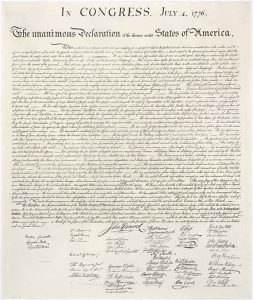
- around Independence Day in 2015, I alluded to the Declaration of Independence just briefly as I highlighted various principles on which the United States of America was founded.
- A year later, I mentioned the Declaration in passing again, in the context of a series that highlighted differences between the Founders’ perspective on rights and the perspective most Americans have on rights today.
- In early July of 2017, I was in the midst of writing a series about the strong connections between man-woman marriage and the gospel, and
- in 2018 I was in the middle of writing a series about the importance of passing along a biblical worldview to members of younger generations.
-
One cannot deal with topics like these week in and week out without seeing ever more clearly the growing threat to religious liberty—and freedom in general—in America, or without realizing this nation has departed a very long way from the place where it started with respect to intangible ideals. As Independence Day approached in 2019, I began to reflect on the lofty and noble statements made by our Founding Fathers in the Declaration of Independence. I realized that their statements showcased and affirmed numerous biblical truths, some of which are overlooked or grossly misunderstood today.
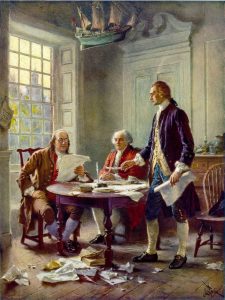
I decided I would write a series about biblical truths embedded in the Declaration (however many I might find). My efforts resulted in a three-part series exploring ten biblical truths embedded in the Declaration of Independence, along with two additional related articles. I learned a great deal in writing the series, and in the process, I became convinced that since most Americans today think of liberty in very different terms than the Founders did, this material needed a wider audience. Part of the problem is that American history is routinely distorted and the Founders’ of the USA unjustly maligned. Another problem is that Americans today are distracted by many other things. They are apathetic regarding history because they believe it to be boring. I can testify that such an assumption is dead wrong. On the page carrying information about the series, I write,
The goal for this three-part series of articles is to mine from the most quoted portion of the Declaration of Independence what I’m calling bedrock principles of liberty. In parts 2 and 3 we will highlight and discuss ten such principles or truths. Some are obvious, but we have become too accustomed to the words and have grown increasingly unaware of their true meaning. In other cases, various ideals are implied rather than explicit, so one has to read between the lines.
Because leftists often use the same words but with very different meanings, people frequently are duped by their emotional and passionate rhetoric. Going back to the Declaration of Independence and unearthing the intent of the Founders is an important step in effectively refuting the claims of the left and upholding the torch of authentic freedom.
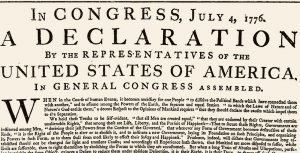
Exploring the Founders’ “Declaration ideals” and the biblical principles they represent also will help us understand why the social justice narrative is both false and destructive, and it will help us effectively oppose that poison narrative at every turn.
Devising a Tool to Help People Understand
Among other interesting facts about the Declaration of Independence, I learned that
-
-
- delegate Richard Henry Lee of Virginia proposed independence in a motion he made to the Second Continental Congress on June 7, 1776.
- On June 10, the delegates agreed to table the resolution until July 1. Meanwhile,
- on June 11, the Second Continental Congress appointed a “Committee of Five” to begin working on a draft of the Declaration. Thomas Jefferson became the principal author.
- On July 2, the Congress voted to approve the Lee resolution, and
- on July 4, after making various changes to the draft, it voted to adopt the Declaration itself.
- Yet it was not until August 2 that most of the signers affixed their names to the document.
-

Therefore, there is a window of approximately 5 weeks between the anniversary of the appearance of Lee’s motion on June 7 and the the anniversary of the signing ceremony on August 2, when interest in the Declaration of Independence and the Founding of America could be potentially strong. Yet, even beyond this time frame, a five-session Bible study series that also dives into history could continue to offer tremendous benefits to both individuals and groups. In addition, pastors can use the material for substantive sermons, ones solidly rooted in Scripture.
So, for many weeks, I have been researching, writing, and drawing on a good bit of my previous work to compile such a study. The result is
Principles of Liberty: Ten Biblical Truths Embedded in the Declaration of Independence
The series was released on Friday, June 12, 2020. Each of the five sessions consists of a background information article and a teaching plan. When the material is used by a group, a facilitator would read the both the background article and the teaching plan, and prepare his or her own teaching approach using the information and resources offered. Each session is designed to be about one hour in length.
Keep this in mind, too: Even though the series is tailored for groups, an individual can interact with the material and learn all the substantive information one would learn in a group setting.
Also, don’t be surprised that not everything is located at wordfoundations.com. I am using the occasion of the release of this series to launch a new website, discoverbedrocktruth.org.
A Worthy Quest
While I could highlight a good many items the material covers—and there are two or three ideas that I would call “bombshell” insights in the series—I believe I can best emphasize the importance of these studies by simply noting that today, we think we know what these five terms mean, and we assume we know what the Founders meant when they used them:
law, liberty, rights, equality, and entitle.

However, regarding each of these, we need to—indeed we must—rediscover what the Founders meant and believed, and we must embrace their perspectives once again! Our departures from their thinking in these five areas actually is a big reason for the increasing loss of freedom we are experiencing in America today. Principles of Liberty: Ten Biblical Truths Embedded in the Declaration of Independence dives into the meaning of each of these terms and the historical context in which the Founders used each one.
Mark it down. Should you decide to take it, this journey absolutely will be one of the most enlightening you’ll ever experience! This is a worthy quest if there ever were one!
Should you decide to take it, this journey absolutely will be one of the most enlightening you’ll ever experience! This is a worthy quest if there ever were one!

But wait! someone is sure to object. Returning to the Founders’ perspective on, say, equality obviously will take our country back to a pre-civil-rights era! No, it won’t. It actually was their perspective on equality that eventually gave birth to the civil rights movement and all the positive changes that have resulted from it! Before that, it was “Declaration ideals” that compelled America to end slavery, even though it took a civil war to do it! We readily can admit the Founding Fathers didn’t apply all they said in the Declaration of Independence with perfect consistency, but I dare say that we don’t apply everything we claim to believe with perfect consistency, either.
It was the Founders’ perspective on equality that eventually gave birth to the civil rights movement and all the positive changes that have resulted from it in the first place!
I hope I’ve whetted your appetite for this series. It is one that is desperately needed today. I invite you to accompany me on a venture probably unlike any you’ve taken before, to learn truths that will help our nation return to its biblical foundation. This is a journey well worth taking!
Join me, won’t you?
Copyright © 2020 by B. Nathaniel Sullivan. All rights reserved.
Pertinent links:
-
-
- Here is the article on which the curriculum series is based.
- Here is the series of which that article is a part.
- Here is an introduction to the curriculum in the form of a Word Foundations blogpost article.
- Here is information about using the curriculum. This brief article contains a list of the ten principles the series covers.
- You can access the Bible study series itself here.
-
Copyright © 2020 by B. Nathaniel Sullivan. All rights reserved.
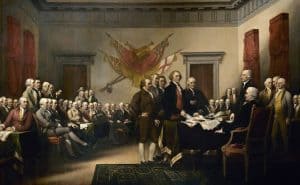
image credit: The Assembly Room in Philadelphia’s Independence Hall

top image: Lightstock, Betsy Ross Flag — Although some recently have sought to associate this flag with racism, it has nothing to do with racism at all. Go here for an article on the matter, and here to read a black gentleman’s response to the controversy.
