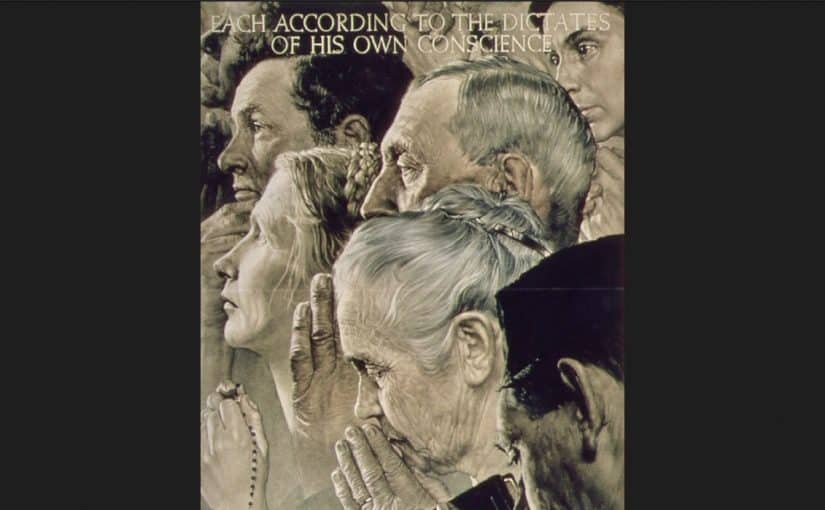
To understand the Founders’ perspective on rights, it is helpful to make a distinction between two types of rights social scientists call “negative rights” and “positive rights.”
The following is excerpted from this article.
Some make a distinction between negative and positive rights and negative and positive liberties, but for our purposes here, we will use these terms interchangeably. Writing at libertarianism.org,1 Aaron Ross Powell explains,
If we want to start very simple, keeping our definitions to just two words each, negative liberty means “freedom from,” while positive liberty means “capacity to.”
Another way of thinking about the difference—though again, it’s a rough one—is to see negative liberty as being about the absence of external limits, while positive liberty is about the absence of internal limits.
As we will see, this isn’t merely theoretical or academic, but extremely practical. It’s very much about our own day-to-day lives. This is where the rubber hits the road.
Powell goes on to offer an example with two scenarios. We summarize his presentation as follows.
Scenario one: Evan has family members in Nebraska and wants to visit them. He lives in Pennsylvania, so he has to travel hundreds of miles to make the desired visit. Seen from the perspective of negative rights, Evan has a right to make the trip, and he is free to make it if he has the time, resources, and other means. It’s important that no one hinder him, or that if anyone tries he or she is held accountable.
What if someone does try to keep Evan away from his family? Let’s say a guy comes along and kidnaps him or steals his car. Describing these situations, we would be correct in saying Evan’s negative right to travel to Nebraska has been violated. However, if in these ways or in others no one keeps our Pennsylvania friend off the road, Evan’s right to journey to the Cornhusker State will not have been thwarted—even if in the end he chooses not to go.
Scenario two: Suppose, though, that Evan lives in poverty and can’t afford to make the long journey. Or perhaps he has a bad back and can’t endure the rigors of travel for a long time. No one is hindering him from going to see his family, so his negative right to travel isn’t being derailed. Even so, describing the situation from a positive rights standpoint, someone would say Evan’s “right” to visit his family members has been undermined because he lacks what he needs to go to Nebraska. Advocates of Evan’s positive right to travel would make the case his ability to journey westward should be secured.
Assuming the state sees Evan’s trip as a right, what might it do? We do not have to guess. It will tax and redistribute resources to make it possible for Evan to visit his family! Even though in this situation we can say that taxpayers’ rights have been violated because they are being forced to pay for a trip for someone they never have met, as well as a trip that brings no measurable benefit to the public at large, in the end these facts don’t matter. Why? Because a positive-rights perspective tends to focus exclusively on the meeting of positive rights, through whatever means.
A positive-rights perspective tends to focus exclusively on the meeting of positive rights, through whatever means.
Keep in mind that with such rights, we aren’t speaking only of Evan, but of countless others as well; and while we probably aren’t talking about excursions to Nebraska, Evan’s trip helps us begin to understand the impact that positive rights can and do have on others.
~~~~~~~~~~end of article quotation~~~~~~~~~~
SUMMARY
Negative rights are the rights we enjoy because government is restricted from forbidding or hindering personal activity. Positive rights are “rights” that are secured when government intervenes in citizens’ lives to give them resources or to otherwise enable them to do or to have certain things. Generally speaking, America’s Founders and early leaders upheld the former, and in only a few instances the latter (such as an individual’s right to a trial by jury). Accordingly, they drafted and ratified the Bill of Rights to the US Constitution, which secured foundational rights of citizens through government limitations.
A PDF file of this graphic is available here.
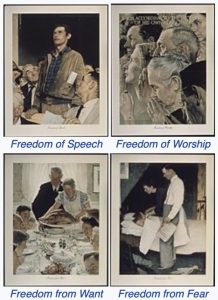
The first two of President Franklin Roosevelt’s “Four Freedoms” —
-
-
- freedom of speech and expression and
- freedom of worship,
-
are negative rights, like those upheld in the Declaration of Independence and guaranteed in the US Constitution.
The last two —
-
-
- freedom from want and
- freedom from fear
-
are positive rights because the government would have to engineer circumstances to try to make them realities — impossible feats in the vast majority of situations.
This page is part of a larger article.
Note: The insight that the first two of the Four Freedoms are qualitatively different from the last two was developing in my mind when I first heard Chuck Colson express it and explain it. I have searched extensively for the source in which he wrote or spoke about this but have been unable to locate it.
Copyright © 2020 by B. Nathaniel Sullivan. All rights reserved.