Discussion Group 1 ~ Each participant in the group should have a copy of this handout.
Exodus 1–2 summarizes the circumstances surrounding the relocation of Jacob and his descendants to Egypt during a severe famine. Joseph, a member of the family who years earlier had been sold into slavery, eventually was elevated to the second-highest position of authority in Egypt. He was being used by God to save many lives because he’d helped Egypt prepare for the widespread famine. Joseph welcomed his father and the members of his family to live with him in Egypt.
After Joseph’s death, “there arose a new king over Egypt, who did not know Joseph,” and he forced Jacob’s descendants, the Israelites, into bondage and slavery. Nearly four hundred years after Joseph’s extended family arrived in Egypt, Moses was born. He could have been killed as an infant because Pharaoh feared an uprising of the Israelites and ordered the male infants thrown in the Nile, he instead was adopted by Pharaoh’s daughter and grew up in Pharaoh’s palace. Aware, however, of his Hebrew heritage, Moses one day killed an Egyptian who was mistreating to a fellow Hebrew. A witness to the deed threatened to make it known, so Moses fled to Midian, where he settled. All the while, “God looked upon the children of Israel, and God acknowledged them.“
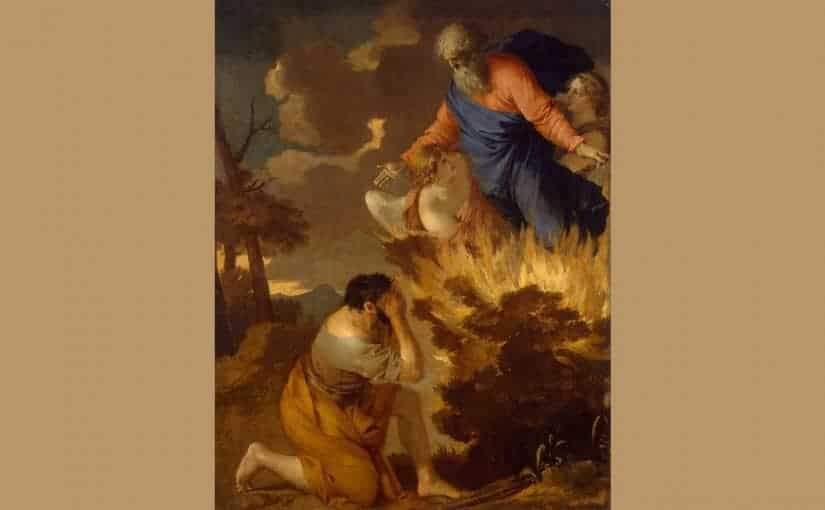
In Exodus 3:1–4:17, God spoke to Moses through a bush engulfed with flame but that was not consumed. In a moment we’ll consider some of the details of Moses encounter with God, but first take a moment to view the encounter as it was depicted in the 1998 animated film, The Prince of Egypt.
Exodus 3:1-4:17 reports details of the conversation between the Lord and Moses.
After God identified Himself, He told Moses He’d “seen the oppression of My people who are in Egypt, and have heard their cry because of their taskmasters,” and that He had “come down to deliver them out of the hand of the Egyptians, and to bring them up from that land to a good and large land, to a land flowing with milk and honey, to the place of the Canaanites and the Hittites and the Amorites and the Perizzites and the Hivites and the Jebusites.”
Then God said to Moses, “Come, I will send you to Pharaoh that you may bring my people, the children of Israel, out of Egypt.”
Moses objected, offering God no less than five excuses as to why he was the wrong man. What were Moses’ excuses, and God’s response to each one?
An article summarizing Moses’ excuses and God’s responses is available here.
Observations and Questions for Reflection and Discussion
-
-
- Note that Moses’ excuses had to do primarily with his feelings of inadequacy and his simply not wanting to do the job God was telling him to do. Note that God did not say, “Moses, normally I don’t send my spokesmen into the political arena to challenge kings and other rulers, but I’m going to make an exception with you.” Nor did Moses say, “Lord, I don’t do politics. I’ll do something that relates to spiritual things if you wish, but the political realm is off limits. You know that!” It is noteworthy that God was sending Moses to confront a political ruler. There is no arena over which He does not have authority. Remember that Jesus stated as much when, in Matthew 28:18, He declared, “All authority has been given to Me in heaven and on earth.”
- Why didn’t God simply lift His people out of slavery and send them on their way to the promised land? He told His people why. In the Book of Exodus, God stated no less than ten times that He would perform His wonders and act to deliver His people out of Egypt so both the Egyptians and the Israelites would know He was and is God. (see Exodus 6:7; 7:2-5,17; 8:22; 10:1-2;14:4,16-18; 16:12; 29:44-46; 31:13; see https://bit.ly/3CNgcg0). But this is politics! someone will say. These are the national affairs! That is precisely the point. Doing God’s work brings glory to Him in every arena His people act, with His help, to perform His will and to do His work! God doesn’t perform miracles and accomplish great things only in the spiritual realm. Moreover, cooperating with Him to do His work in every sphere of life — including law and public policy — brings Him glory and sends forth the message that He and He alone is God, and God over all.
- Keep in mind that to and through Israel, the nation that God was establishing when He brought His people out of Egypt, God would give His law. When we think of His law, we rightly think first of the Ten Commandments (see Ex. 20:1-17), the bedrock foundation of the laws of all civilized, free societies. This is the realm of public policy; there is no escape from this fact. Although Christians should clearly understand and be able to articulate that obeying the law does not save, Christians should love God’s law nonetheless; because they, of all people, should appreciate the good that comes from revering it and obeying it (see Psalms 1; 19:7-11; 119).
- Of course, we can readily understand that the idea of confronting Pharaoh would be intimidating to Moses, perhaps especially since he grew up in Pharaoh’s household. Yet part of the discomfort he felt may have resulted from the authority Pharaoh had. Moses knew he would be putting everything on the line to confront the Egyptian head-of-state. What risks do you think 21st-century American pastors feel when they think about declaring God’s truth in the realm of politics and public policy? Quite likely, they tend to feel taking these kinds of stands will drive people away from the church, but might it attract some? And might it also eventually attract some that initially were driven away? Explain how these scenarios could come to pass.
- What is the potential cost of remaining silent? Could people conclude that the Christian gospel and the Christian faith have nothing to say about all the issues pastors and Christians never or rarely address, for fear of offending people?
- Imagine Moses were standing in the midst of your group. What might he say to pastors and Christians in general about the risks and rewards of bringing God’s message to those in authority?
-
Copyright © 2023. All rights reserved.
Unless otherwise indicated, Scripture has been taken from the New King James Version®. Copyright © 1982 by Thomas Nelson, Inc. Used by permission. All rights reserved.