
The complete article/teaching plan is available here.
The Home Page for the Bible study series is available here.
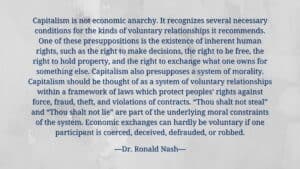
Background information: Principles of Liberty: The Biblical Case for Free Enterprise is a six-session Bible study series highlighting 10 biblical principles that are consistent with and that uphold the free enterprise economic system. Many of these tenets are adapted from a paragraph in an article by the late Dr. Ronald Nash in which he affirms the free enterprise system as consistent with biblical teachings. Here is the paragraph.
The ten biblical principles the Bible study explores available in a PDF file here.
Session 2 deals with the first and second of the ten principles. The following excerpt from session 2 examines the second.
Principle Two
The voluntary relationships and the voluntary involvement of individuals that make capitalism work are antithetical to government orchestration of private decisions and actions. Scripture affirms personal freedom in the economic realm.

Encourage your participants to think of the many relationships a player in the free enterprise economic system has, and that these are voluntary, not forced, with regard to
-
-
- purchases of goods
- purchases of services
- food purchases
- lease and rental agreements
- real estate
- communication options (including phone and internet services)
- employment (whether one is an employee or an employer)
- the location of one’s residence
- travel
- entertainment choices
- investments
- charitable contributions
- advertising and marketing (whether one is a producer or consumer)
-
Of course, some of the arrangements may involve contracts or other agreements; and a variety of factors may, and usually do, influence decisions and the duration of commitments. This does not change the fact that transactions and relationships themselves are voluntary, not forced. A person is obligated once he or she enters into an agreement, but not before.
All of this relates to property rights, a matter we will dive into and explore during Session 5. For now, the emphasis on voluntary relationships is critical. We engage in these relationships so frequently that we fail to appreciate the fact that they are not orchestrated. We glean this material and adapt it from this article.
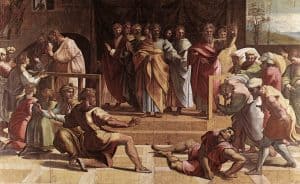
Acts 2:44-45 and 4:34-35 are used by advocates of socialism and “social justice” in making the case that the Bible teaches socialism. But does it? We’ll use these same Scriptures to show that it does not. Acts 5:1-11 also is pertinent to our discussion. Let’s consider five points. These have been adapted from this article.
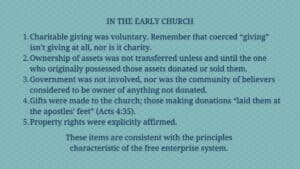
Divide the large group into five smaller groups and ask each group to appoint a willing leader, one who will facilitate a brief discussion. Here are the assignments. After a few minutes, ask each group to give a brief report, or summary, of its discussion. For your convenience, here are the assignments on one page. They’re also printed below.
Do Acts 2:44-45 and 4:34-35 indicate the early church practiced socialism? Also, how are the economic relationships of capitalism and socialism different? Let’s have a look at these passages. Acts 5:1-11 also is pertinent to our discussion. Here are the Bible passages in context.
-
-
- Group 1: Discuss these insights: The spontaneous generosity of church members arose in a context of a community of committed believers who feared God, praised God, and were overcome with a sense of awe regarding what He was doing in their midst. Generosity is commanded in Scripture (here are three of many such passages: Prov. 11:24-25; Acts 20:35; 1 Tim. 6:17-19). When “giving” is coerced, it is not giving; nor is it charity. Socialism and its related systems advocate a forced redistribution of wealth and resources. Contrast the outcome of spontaneous, voluntary giving in the church (God is glorified) to the outcome when transfer of wealth is forced by the government (the state is seen as the source of resources and gets credit for meeting needs). What additional things occur?
- Group 2: Discuss these insights: When those involved in the early church “had all things in common” (Acts 2:44), none of the goods that made up the store of common resources was owned by the group from the outset; instead, each item of value, whether money or goods, was donated freely and voluntarily. Ownership of assets was transferred when the original owner donated or sold them. Describe how God is glorified and relationships are strengthened within the church when giving to meet needs is voluntary. Contrast this scenario to what happens to relationships when the government taxes wealth and redistributes it to those deemed to be in need.
- Group 3: Discuss these insights: The free and voluntary donations came from individuals and families who owned them privately. The government was not involved; nor was the community of believers considered to be owner of anything that was not donated. What happens to relationships when someone assumes he owns something he really does not?
- Group 4: Discuss these insights: Those who gave to meet the needs of fellow church members laid their donations “at the apostles’ feet” (4:35). That makes it a “slam dunk” that the church didn’t engage in socialism! Advocates of socialism want people’s money to go to the government, not to the church! Discuss: What happens when the state starts to meddle in the affairs of the church?
- Group 5: Discuss these insights: Property rights and the right to voluntarily engage in economic transactions were explicitly affirmed, even while the church still was using the common store approach. In Acts 5:1-11, Peter himself affirmed these rights. When donations were being made to the common treasury, Ananias and Sapphira, a husband and wife, sold a piece of property and brought a portion of the proceeds to the apostles. They claimed they were bringing the entire amount but actually held a portion back. Their primary offense wasn’t failing to donate all of the proceeds, but lying about their gift. To their own peril, they lied to God Himself. Discuss: How did Peter affirm property rights in Acts 5:3-4? What does the phrase “in your own control” mean in practical terms?
-
Display the graphic below as you summarize the points highlighted by the spokespersons from the five discussion groups.
Here is an overall summary: The relationships on which capitalism depends are voluntary, not forced. If economic relationships are forced, the system in place isn’t free enterprise. Historian and sociologist Alvin Schmidt observes, “If we fail to understand that the involuntary, coercive nature of socialism and its state socialist programs is highly incompatible with the economic practices that some of the early Christians engaged in when they voluntarily ‘had all things in common’ (Acts 2:44, NKJV), we may think that socialism is a good way to practice Christianity.…[Yet] something that is done involuntarily or as a result of compulsion is no longer Christian.”1
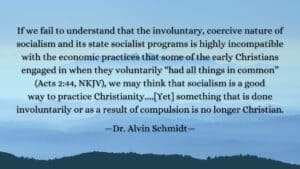
Share this quote from Dr. Schmidt. Express to participants they may remember a similar quote from him from their assignment, “Choose Wisely.” The point bears repeating here, because it is so easy to take for granted the liberty we have, and the relationships in which we freely engage, when we perform all kinds of economic transactions under the free enterprise system.…
Session 2: Conclusion
Say: As we continue to look at the free enterprise system and biblical teachings, we will see increasing evidence the Bible affirms the core principles of the free market and rejects the tyranny of socialism and similar systems.
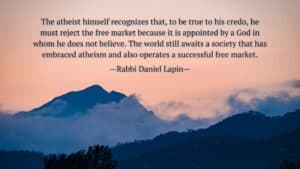
Share that an orthodox rabbi, Daniel Lapin, made this statement. It is worthy of serious reflection.
The atheist himself recognizes that, to be true to his credo, he must reject the free market because it is appointed by a God in whom he does not believe. The world still awaits a society that has embraced atheism and also operates a successful free market.
—Rabbi Daniel Lapin2—
Say: We’ll begin our next session by looking at this quote more closely and providing a rationale for it.
Close in prayer: Lord, thank You that the free enterprise system allows for freedom without chaos. Thank Him for ordered liberty. In Jesus’ name. Amen.
Copyright © 2021 by B. Nathaniel Sullivan. All rights reserved.
top image credit: Photo by Bence Balla Schottner on Unsplash
Unless otherwise indicated, Scripture has been taken from the New King James Version®. Copyright © 1982 by Thomas Nelson, Inc. Used by permission. All rights reserved.
Notes:
1Alvin J. Schmidt, How Christianity Changed the World, (Grand Rapids: Zondervan, 2004), 205-206.
2Rabbi Daniel Lapin, America’s Real War: An Orthodox Rabbi Insists that Judeo-Christian Values Are Vital for Our Nation’s Survival, (Sisters, OR: Multnomah Publishers, 1999), 217.