The classic text highlighting the responsibility of God’s spokesperson to issue warnings is Ezekiel 33:1-9.
331 Again the word of the Lord came to me, saying, 2 “Son of man, speak to the children of your people, and say to them: ‘When I bring the sword upon a land, and the people of the land take a man from their territory and make him their watchman, 3 when he sees the sword coming upon the land, if he blows the trumpet and warns the people, 4 then whoever hears the sound of the trumpet and does not take warning, if the sword comes and takes him away, his blood shall be on his own head. 5 He heard the sound of the trumpet, but did not take warning; his blood shall be upon himself. But he who takes warning will save his life. 6 But if the watchman sees the sword coming and does not blow the trumpet, and the people are not warned, and the sword comes and takes any person from among them, he is taken away in his iniquity; but his blood I will require at the watchman’s hand.’
7 “So you, son of man: I have made you a watchman for the house of Israel; therefore you shall hear a word from My mouth and warn them for Me. 8 When I say to the wicked, ‘O wicked man, you shall surely die!’ and you do not speak to warn the wicked from his way, that wicked man shall die in his iniquity; but his blood I will require at your hand. 9 Nevertheless if you warn the wicked to turn from his way, and he does not turn from his way, he shall die in his iniquity; but you have delivered your soul.
While this passage is specific to Ezekiel’s responsibility to warn those in the path of judgment, it also reflects the duty all believers have to sound the alarm and convey urgent messages from God. This calling has a rich history in both the Old Testament and the New Testament. Consider these men whom God appointed to warn the people of their generation.
God’s Spokesmen Warned Their Contemporaries
Noah. Hebrews 11:7 tells us, “By faith Noah, being divinely warned of things not yet seen, moved with godly fear, prepared an ark for the saving of his household, by which he condemned the world and became heir of the righteousness which is according to faith.” We read this verse and we’re tempted to cringe, aren’t we? The culture has so drilled into our minds that we must not judge—and we most certainly must never condemn—that we feel a bit uncomfortable with this statement about Noah. While it’s true that Jesus said, ““Judge not, that you be not judged,” He didn’t mean for His followers to make no judgments at all. Discernment is essential. Jesus actually was telling believers not to be hypocritically judgmental.
The word translated condemned means just that—to condemn, but it also means to make others’ sins evident and conspicuous by one’s own righteous example. In Hebrews 11:7, this latter definition applies. We must never think this means Noah was arrogant, or condescending, or prideful about his righteousness or about the wickedness prevalent among his contemporaries. On the contrary, I believe he grieved for them and encouraged them to repent. In 2 Peter 2:5, Peter referred to Noah as a “preacher of righteousness.” Obviously Noah proclaimed righteousness through his pure life and by building the ark in obedience to God, but he surely also must have encouraged those around him to join him on the ark before God’s judgment fell. Sadly, however, only “a few, that is, eight souls, were saved through water” because they took refuge in the ark (1 Pet. 3:20).
Moses. God used Moses to warn Pharaoh repeatedly about divine judgment. He also used Moses to warn the Hebrews of the coming death angel and to encourage them to run to safety by placing blood on the sides and tops of the doorways of their homes according to God’s instructions. Hebrews 11:27-28 says of Moses, “By faith he forsook Egypt, not fearing the wrath of the king; for he endured as seeing Him who is invisible. By faith he kept the Passover and the sprinkling of blood, lest he who destroyed the firstborn should touch them.”
Jonah. We learn from the Old Testament book that bear’s Jonah’s name, “Now the word of the Lord came to Jonah the son of Amittai, saying, ‘Arise, go to Nineveh, that great city, and cry out against it; for their wickedness has come up before Me’” (Jonah 1:1-2). Jonah actually wanted God to condemn the Ninevites, but the Lord went out of His way to show Jonah that he needed to be an agent of divine mercy and grace (see vv. 3-17). How did God want Jonah to be such an agent? By warning the Ninevites of God’s coming judgment! After the reluctant prophet’s experience inside the fish’s belly (see chapter 2), God instructed Jonah once more to preach to Nineveh (see 3:1-2). At last, he obeyed. Jonah 3:4-10 reads in part,
34 And Jonah began to enter the city on the first day’s walk. Then he cried out and said, “Yet forty days, and Nineveh shall be overthrown!” 5 So the people of Nineveh believed God, proclaimed a fast, and put on sackcloth, from the greatest to the least of them.…10 Then God saw their works, that they turned from their evil way; and God relented from the disaster that He had said He would bring upon them, and He did not do it.
You’d think Jonah would have been pleased with such an overwhelming response to his preaching, but he hadn’t yet learned just how deep and how wide God’s love and grace really were. God put Jonah back in the classroom. While the Lord earlier had used an animal to teach Jonah, this time He used a plant. The plant offered Jonah much needed shade at first, but then it withered and died, and Jonah was baking in the sun. When Jonah complained about the demise of the plant, God said to him, “You have had pity on the plant for which you have not labored, nor made it grow, which came up in a night and perished in a night. 11 And should I not pity Nineveh, that great city, in which are more than one hundred and twenty thousand persons who cannot discern between their right hand and their left—and much livestock?” (Jonah 4:10-11).
Despite Jonah’s imperfections, God used this reluctant prophet to urge the Ninevites to repent of their sins and thereby experience God’s mercy and grace.
John the Baptist. John prepared the way for the Messiah’s arrival by warning the people to repent and to change their way of living. He
3 went into all the region around the Jordan, preaching a baptism of repentance for the remission of sins, 4 as it is written in the book of the words of Isaiah the prophet, saying:
“The voice of one crying in the wilderness:
‘Prepare the way of the Lord;
Make His paths straight.
5 Every valley shall be filled
And every mountain and hill brought low;
The crooked places shall be made straight
And the rough ways smooth;
6 And all flesh shall see the salvation of God.’ ”
7 Then he said to the multitudes that came out to be baptized by him, “Brood of vipers! Who warned you to flee from the wrath to come? 8 Therefore bear fruits worthy of repentance, and do not begin to say to yourselves, ‘We have Abraham as our father.’ For I say to you that God is able to raise up children to Abraham from these stones. 9 And even now the ax is laid to the root of the trees. Therefore every tree which does not bear good fruit is cut down and thrown into the fire.”
10 So the people asked him, saying, “What shall we do then?”
11 He answered and said to them, “He who has two tunics, let him give to him who has none; and he who has food, let him do likewise.”
12 Then tax collectors also came to be baptized, and said to him, “Teacher, what shall we do?”
13 And he said to them, “Collect no more than what is appointed for you.”
14 Likewise the soldiers asked him, saying, “And what shall we do?”
So he said to them, “Do not intimidate anyone or accuse falsely, and be content with your wages.” (Luke 3:3-14).
Let us not forget that John also warned Herod, telling him, “It is not lawful for you to have your brother’s wife” (Mark 6:18). He paid for that action with his life, but he didn’t fail to declare the truth, even to a king.
Peter. At Pentecost, a mere seven weeks after Jesus rose from the dead, Peter preached the good news of salvation to the people in Jerusalem. His message included warnings. You can read Peter’s sermon in Acts 2:14-36. After the people heard the fisherman-turned-evangelist preach,
37 they were cut to the heart, and said to Peter and the rest of the apostles, “Men and brethren, what shall we do?”
38 Then Peter said to them, “Repent, and let every one of you be baptized in the name of Jesus Christ for the remission of sins; and you shall receive the gift of the Holy Spirit. 39 For the promise is to you and to your children, and to all who are afar off, as many as the Lord our God will call.”
40 And with many other words he testified and exhorted them, saying, “Be saved from this perverse generation.” 41 Then those who gladly received his word were baptized; and that day about three thousand souls were added to them (Acts 2:37-41).
Yes, Peter warned his hearers of God’s coming judgment and encouraged them to receive divine forgiveness for their sins. In fact, here’s how the translators of the New International Version rendered Acts 2:40: “With many other words he warned them; and he pleaded with them, “Save yourselves from this corrupt generation.”
Paul. Inspired by the Holy Spirit, the apostle Paul wrote, Christ “we preach, warning every man and teaching every man in all wisdom, that we may present every man perfect in Christ Jesus.” (Col. 1:28).
Note: While this brief article highlights warnings from several of God’s spokesmen, no spokesman ever outranked Jesus, who frequently issued warnings to His hearers.
This article is available in a printable PDF file here.
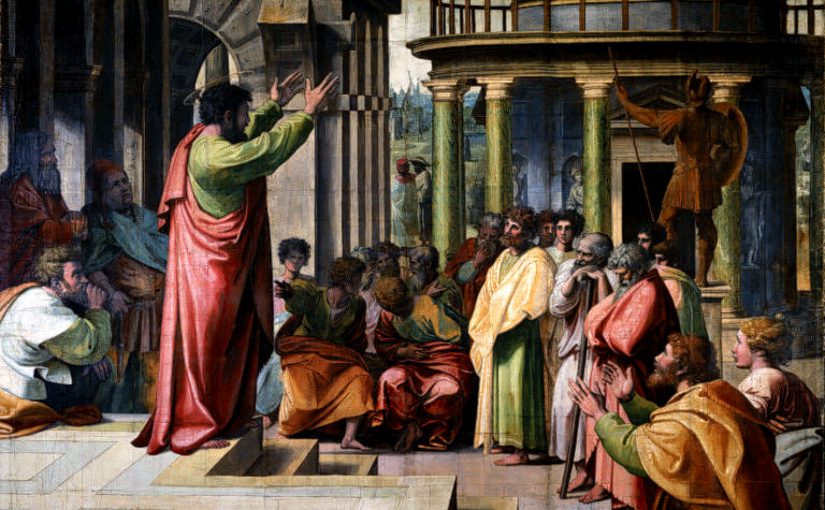
top image: Paul delivering his sermon in Athens (see Acts 17:16-34).
.jpg)
Unless otherwise indicated, Scripture has been taken from the New King James Version®. Copyright © 1982 by Thomas Nelson, Inc. Used by permission. All rights reserved.
One quotation is from the New International Version. THE HOLY BIBLE, NEW INTERNATIONAL VERSION®, NIV® Copyright © 1973, 1978, 1984, 2011 by Biblica, Inc.® Used by permission. All rights reserved worldwide.
Websites and videos in this article have been cited for information purposes only. No citation should be construed as an endorsement.
Copyright © 2023 by B. Nathaniel Sullivan. All rights reserved.