Participants’ Guide
Debriefing for Session 1: Social Justice Versus Biblical Justice, Part 1
Debriefing for Session 2: Social Justice Versus Biblical Justice, Part 2
Debriefing for Session 3: Situationism
Debriefing for Session 4: Antinomianism
Debriefing for Session 5: Pietism
Debriefing for Session 6: Social Justice, A Counterfeit Gospel, Part 1
Debriefing for Session 7: Social Justice, A Counterfeit Gospel, Part 2
Situation Ethics, or situationism, claims to be an ethical system, but it actually is a system of non-ethics and emotions.
Situationism
I became a physician in order to help save lives. I am at once a physician, a citizen, and a woman, and I am not willing to stand aside and allow the concept of expendable human lives to turn this great land of ours into just another exclusive reservation where only the perfect, the privileged, and the planned have the right to live. ~
The fight for the right to life is not the cause of a special few, but the cause of every man, woman and child who cares not only about his or her own family, but the whole family of man.
—Mildred Fay Jefferson1*—
In 1976, Francis Schaeffer’s landmark work How Should We Then Live?2* was published. The book is an account of “The Rise and Decline of Western Thought and Culture.”
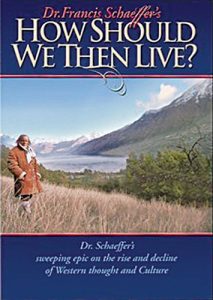 The following year, Dr. Schaeffer’s ten-part film series by the same name was released by Gospel Films. The film series was welcomed with enthusiasm. A short time later, in 1979, Schaeffer partnered with future Surgeon General C. Everett Koop to write Whatever Happened to the Human Race? Exposing our rapid yet subtle loss of human rights. The themes covered in this book also were highlighted in a film series by the same title, this one consisting of five parts.
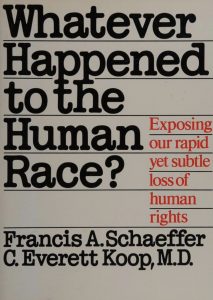 In a sense, Whatever Happened to the Human Race? is a sequel to How Should We Then Live? The 1979 book addressed topics that, only a few decades earlier, would have been considered unthinkable: abortion for the sake of convenience, infanticide, and euthanasia. Already, in 1979, a mere six years after the US Supreme Court issued its decision in Roe vs. Wade, abortion on demand was being vigorously defended. “Choice” and “women’s healthcare” became the mantras under which radical feminists and their allies made the case that it wasn’t a baby, but merely “a blob of tissue.” Today, a growing number of abortion defenders admit it really is a baby we’re talking about, but they defend abortion anyway (here,3* here,4*and here5*). Some even brag6* about their abortions (also go here7*). The notion the pro-choice crowd wanted abortion to be safe, legal, and rare was a total ruse.8*
Down, Down, Down
The chapter on euthanasia in Whatever Happened to the Human Race? is titled “Death by Someone’s Choice,” In it, Schaeffer and Koop ask some penetrating rhetorical questions.
Life is a continuum from conception until natural death. Since life is being destroyed before birth, why not tamper with it on the other end?
Will a society which has assumed the right to kill infants in the womb — because they are unwanted, imperfect, or merely inconvenient — have difficulty in assuming the right to kill other human beings, especially older adults who are judged unwanted, deemed imperfect physically or mentally, or considered a possible social nuisance?9*
Sandwiched between the chapter on abortion and the chapter on euthanasia is a chapter on the horror of infanticide, wherein the authors write about how the primary goal of medical science has been turned on its head. It actually wasn’t that long ago that medical students completed their formal academic training and residencies and moved into their professional careers with a clear sense of mission and intention to do all they can to heal patients — to relieve their suffering by saving their lives. Yet, over a very short period of years, the emphasis on relieving suffering shifted. It increasingly became the case that the suffering to be relieved wasn’t necessarily that of the patient, but of those to whom the patient had become or might become a burden. After all, if the severely impaired patient who needs ongoing medical attention and care dies, the burden on his or her family members is eliminated, and so is their suffering. Thus, “in a strange way, it can still be said that doctors [still] are alleviating suffering and saving lives.”10*
Schaeffer and Koop essentially warned their readers, and they warn their audience today, not to be fooled by these diabolical and deceptive word games. Saving lives isn’t really saving lives if patients are killed directly or if they are murdered by withholding from them essential, life-saving treatments.11* This is true even if and even when the killing is done in the name of “alleviating suffering.” Feel-good rhetoric does not change the realities involved!
Why has it been so easy to devalue human life? Perhaps part of the reason was the popularity of Joseph Fletcher, who said (among other things),
People [with children with Down’s syndrome]… have no reason to feel guilty about putting a Down’s syndrome baby away, whether it’s ‘put away’ in the sense of hidden in a sanitarium or in a more responsible lethal sense. It is sad; yes. Dreadful. But it carries no guilt. True guilt arises only from an offense against a person, and a Down’s is not a person.12*
If this doesn’t send chills down your spine, will anything?
→ What steps can the church take to make it harder for society to devalue human life? How can insisting that every human being is a person help?
→ Why do so many people say “Well, you can’t legislate morality?” We legislate it all the time! When slavery was outlawed, morality was legislated, and rightly so.
→ How can we as Christians work, not just to elect good people and to pass good laws, but also to win hearts and minds?
→ How many in the church need to be informed about these issues and wake up to the dangers involved? How can churches help their own congregants understand?
Making “Alleviating Suffering” Justification for Murder
But wait! someone will say. The new “approach” isn’t just eliminating the suffering of family members or others who would have the responsibility to care for the person, but also the suffering of the one who would struggle to live a “normal” life (to whatever degree he or she could).

This kind of thinking shows just how convoluted the discussion over what medical care is and should be has become. It shows the strong influence of situationism, which we explored during Session 3 and about which we’ll learn more during this debriefing. Killing someone whose condition could be improved though medical treatment, or otherwise intentionally allowing him or her to die, isn’t alleviating suffering; it is committing murder (see Ex. 20:13). Nevertheless, we can respond with rational arguments to the objection that has been raised. Let’s do that by turning once more to authors Schaeffer and Koop.
The two decided it was important to give those who had suffered from debilitating and even life-threatening conditions a platform from which to express their own perspectives on life, despite any of the ongoing challenges they were facing. At the time, Dr. Koop was serving on the medical staff of the Children’s Hospital of Philadelphia. His specialty was pediatric surgery. His title was surgeon-in-chief, and he held the position from 1946 until 1981. In early 1982, he became US Surgeon General under President Ronald Reagan.13*
Dr. Schaeffer, an orthodox Christian and an astute cultural observer, had long warned in his writings about the departure of American society and culture from a biblical foundation.14* These two men, therefore, were well qualified to interview and to offer keen insights on the statements of those they invited to share. At the same time, the authors worked to make sure the individuals they interviewed gave honest and sincere responses.
They were not coached in any way concerning what answers they were to give to questions. They were told that we were making some documentary movies and were writing a book on the general topic of “Whatever Happened to the Human Race?” We allowed them to talk with each other for about an hour, in order to feel comfortable before being asked to participate in our plans.15*
I’m Grateful to Be Alive!
Dr. Koop invited four of his patients to share their perspectives. Each one had been born with a life-threating congenital defect and had undergone surgery withing 48 hours of birth. These four joined four others who, during the years of their early childhood, had experienced life-endangering health issues that had to be corrected surgically. In at least some cases, multiple major surgeries were required. When Schaeffer and Koop assembled and interviewed these eight individuals for their book and film project, the youngest was eleven and the oldest, thirty. Here is a summary of their backgrounds.
-
-
-
- Major impairments in the bladder, the lower bowel, and the esophagus had threatened the life of one of the individuals. These impairments were present in the individual at birth, but the surgeries proved to be life-saving.
- Another had no esophagus at birth, so a substitute esophagus had to be formed from the individual’s colon and implanted.
- A third had undergone twenty-seven operations to correct multiple congenital defects present “down the midline of his body” soon after he was born.
- The fourth had been born with a tumor that had invaded the tongue, and through a series of surgeries, that organ was almost completely removed.
- The remaining four had developed tumors during their childhood years. While one of the tumors was benign, it was invading the bones of the individual’s face. Multiple operations had had improved the situation, but apparently not without noticeable scars and blemishes.
- Of the remaining three people, one had undergone treatments that apparently included surgery for uterine cancer, another for cancer of the parotid gland, and the third for cancer of the adrenal gland.16*
-
-
Did any of these people say they wished they had been left untreated? Did any of them say they would rather have died than been forced to endure all they had faced? No. Here are some of the comments they offered. These are quotations from the people themselves. These and similar comments were featured in the film series in Episode 2, which is available online, at You Tube.17*
-
-
-
- Because the start was a little abnormal, it doesn’t mean you’re going to finish that way. I’m a normal, functioning human being, capable of doing anything anyone else can.…
- At times it got very hard, but life is certainly worth living. I married a wonderful guy and I’m just so happy.…
- At the beginning it was a little difficult going back to school after surgery, but then things started looking up, with a little perseverance and support. I am an anesthetist and I’m happily married. Things are going great for me.…
- I really think that all my operations and all the things I had wrong with me were worth it, because I really enjoy life and I don’t really let the things that are wrong with me bother me.…
- If anything, I think I’ve had an added quality to my life — an appreciation of life. I look forward to every single morning.…
- Most of the problems are what my parents went through with the surgery. I’ve now been teaching high school for eight years and it’s a great joy.…
- They spend millions of dollars to send men to the moon. I think they can spend any amount necessary to save someone’s life. A human life is so important because it’s a gift — not something that you can give, so you really don’t have the right to take it either.…
- I really don’t consider myself handicapped. Life is just worth living. What else can I say?…18*
-
-
In addition to these, Craig, who was born without arms below his elbows and without a left leg, offered comments that the authors featured. Craig was involved in Dr. Schaeffer’s ministry — L’Abri— in Switzerland.19* A graduate of Cal State in philosophy and at the time of the publication the book a student in theology at Covenant Seminary, Craig offered his insights when he was asked about those who would try to make the case that babies born with disabilities like his should be allowed to die. Here is a portion of what he said, and everything he said that the authors quoted:

They don’t really see that what they are talking about is murder. I know, when I was born, the first thing my dad said to my mom was that “this one needs our love more.” An individual with a handicap needs our love and needs us to help him grow into the being that God has made him to be. They are advocating that we destroy these children before they’re even given a chance to live and to conquer their handicaps.
I’m very glad to be alive. I have a full, meaningful life. I have many friends and many things that I want to do in life. I think the secret of living with a handicap is realizing who you are — that you’re a human being, somebody who is very special — looking at the things that you can do in spite of your handicap, and maybe even through your handicap.20*
→ What kinds of things can people accomplish through their handicaps that they cannot accomplish without them?
Human Life: Priceless

Of course, these young men and women offer powerful perspectives on the need to uphold the intrinsic value of life. We must uphold it, yes; but we must not uphold it in an arbitrary way. In other words, our core reason for upholding life as having intrinsic value must be that it really does have intrinsic value. We must return to the foundation of God’s law. We must return to a conviction that every person is infinitely valuable because God has created each one, however imperfect he or she may seem, in His image. We must abandon emotional, groundless strategies for making ethical decisions.
Joseph Fletcher and his system situation ethics have destroyed societal cohesion in America because Fletcher, using situation ethics, uprooted this nation from its bedrock Christian foundation. One might think that this uprooting has left America in an ethical vacuum, but Joseph Fletcher and his work left this nation in a far worse situation. Fletcher didn’t simply remove the ethical foundation in America that was built on biblical teachings; he replaced it with a foundation of non-ethics — totally ungrounded, or, we might say, completely grounded in feelings, which are fluid, unreliable, and unfixed.21*
As bad as it is for a nation to have no ethical foundation, it’s worse when the people living in that country to have none and yet believe they have one anyway. That’s the disastrous place to which Fletcher brought us. Here’s another example of a quote from Fletcher showcasing the kind of rhetoric with which he accomplished his evil work:
Christian situation ethics has only one norm or principle or law…that is binding and unexceptionable, always good and right regardless of the circumstances. That is “love” — the agape of the summary commandment to love God and neighbor. Everything else without exception, all laws and rules and principles and ideals and norms, are only contingent, only valid if they happen to serve love in any situation.22*
We Don’t Just Need Love; We Need Truth Too
This, of course, sets the stage for any and all definitions of love to be thought of as valid. Thus, all that is left to guide us are our feelings, and they are not rooted in reality. You see, you can label any action “loving” or “compassionate.” You can point to practically any practice and make a case that implementing it would provide “the greatest good for the greatest number.” Schaeffer and Koop expose the steps involved in making the case to take innocent lives. In doing so, they clearly demonstrate the need to return to the bedrock foundation of God’s law.
At first we hear much talk of compassion for the unwanted. The discussion moves on to “rights,” then to “my” rights and soon to pure “economics.” The discussion of life must be brought back to where it belongs — not to emotional, extreme examples, not to selfish questions for rights, not to expedience, and certainly not to economics. The matter should be discussed in terms of right and wrong.23*
Morality and ethics, remember, aren’t just about issues related to life and whether or not it should be preserved. They’re also about issues relating to theft, lying, and property rights, to name just a few. People have been conditioned to feel good, not only about murder (as horrible as that is), but also about theft, lying, and any number of other violations of God’s law, not to mention civil law.
→ How does Joseph Fletcher’s system of situation ethics make breaking every one of the Ten of the Ten Commandments easier?
→ Even though we don’t hear much about Fletcher and situation ethics by name today, what evidence do we see in society of their influence?
God’s Law: A Charter for Liberty
If the matter is discussed “in terms of right and wrong,” as Dr. Schaeffer and Koop contend it should be, then we need to clearly understand the essential need for a set of absolute ethical standards. Nothing can be right or wrong without absolute truth. There is no better place to start than with the Ten Commandments; you will find no better or solid foundation for order in society than this set of moral and ethical guidelines.
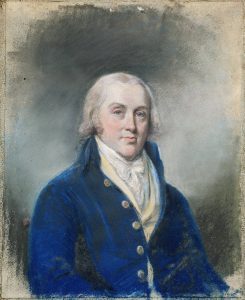
James Madison (1751-1836) is credited with saying, “We have staked the whole future of our new nation, not upon the power of government; far from it. We have staked the future of all our political constitutions upon the capacity of each of ourselves to govern ourselves according to the moral principles of the Ten Commandments.”24* Commandments or commands assume a Supreme Authority — God. Further, they assume accountability to God. When people believe in a God to whom they are accountable, they tend to behave, or, as Madison expressed it, “govern” themselves. Daniel Webster (1782-1852) declared, “The most important thought that ever occupied my mind is that of my individual responsibility to God.”25*
Nine Takeaways from this Debriefing
Here are nine things we need to understand about the Ten Commandments, situationism, and how we as Christians need to respond to the challenges before us. When we comprehend these items, we also will understand to a far greater extent the damage that situation ethics has done in America. Further, we’ll be better equipped to bring our nation back to rest on a solid foundation.
First, the Ten Commandments constitute a set of absolute standards. Absolute standards are standards that apply to everyone, everywhere, at all times, and under all circumstances.
→ Joseph Fletcher’s tools for uprooting America from a biblical ethical foundation were 1) emphasizing love as the overarching standard for making ethical decisions, and 2) emphasizing that one’s circumstances also had to be thoroughly considered in making those decisions. Why were these tools so effective? In other words, why did people buy into these two ideas so thoroughly? Where did it take America?
→ Describe how following these two tenets (upholding “love” and focusing on one’s circumstances in making ethical decisions) moved the nation from a foundation of ethical bedrock to one of sand. See Matthew 7:24-29, which you considered during the Bible study session. Note verse 29: Jesus “taught them as one having authority, and not as the scribes.” His teaching with authority is consistent with His claims in verse 24-25 that “whoever hears these sayings of Mine, and does them, I will liken him to a wise man who built his house on the rock: and the rain descended, the floods came, and the winds blew and beat on that house; and it did not fall, for it was founded on the rock.” Also see Matthew 28:18.
→ It also is noteworthy that Jesus didn’t cancel out the Ten Commandments. He said in Matthew 5:17-18, “Do not think that I came to destroy the Law or the Prophets. I did not come to destroy but to fulfill. For assuredly, I say to you, till heaven and earth pass away, one jot or one tittle will by no means pass from the law till all is fulfilled.” While the Jewish ceremonial law was superseded by Christ, God’s ethical and moral principles were not. We will examine this reality more thoroughly during the next Bible study session. Meanwhile, for now, describe to the best of your understanding key differences between ceremonial law and ethical law.
Second, adherence to the Ten Commandments on the part of a people makes order in society possible.
→ How is this the case? What are some benefits that come with order in society? (See 1 Tim. 2:1-4.) What does the opposite of order in society — chaos — look like? Why can’t people tolerate it for long?
→ Note that when chaos increasingly prevails in a society or nation, government has to come in and impose order. What are some key differences between order imposed by government’s iron fist and order that is a reality because people are policing themselves?
Third, because adherence to the Commandments makes order possible, it makes freedom possible, as well.
→ We discussed this in our debriefing for Session 1. Do you remember what we said about the Ten Commandments? They are not only a list of restrictions, but also a list of inherent rights people are obligated to respect and honor. Inherent, God-given rights are called negative rights because they require people and government to stay out of the way so people who wish to exercise them can do so.
→ Here’s what we’ve said — more than once. Repeating it helps it sink in! How well do you understand these ideas?
Negative rights are the rights we enjoy because government is restricted from forbidding or hindering personal activity. Positive rights are “rights” that are secured when government intervenes in citizens’ lives to give them resources or to otherwise enable them to do or to have certain things. Generally speaking, America’s Founders and early leaders upheld the former, and in only a few instances the latter (such as an individual’s right to a trial by jury). Accordingly, they drafted and ratified the Bill of Rights to the US Constitution, which secured foundational rights of citizens through government limitations.
→ Most positive rights are artificial rights because government has to create them and maintain them. They’re also arbitrary; government gives them, so government can take them away. Are abortion “rights” positive or negative rights? Explain. Is same-sex “marriage” a positive or negative right? Explain your answer. Is the right to travel a positive or negative right? The right to work and increase one’s wealth? (See Ex. 20:8-11; Deut. 8:18; Prov. 13:11; available at https://bit.ly/3ZdyVel).
Fourth, significantly, God gave the Ten Commandments to Moses right after releasing His people from bondage in Egypt. The people were moving from slavery to freedom — but they couldn’t enjoy true freedom as a nation if they didn’t honor and obey God’s law. In other words, to experience true freedom and liberty, you need to live under God’s law.
→ In your own words, describe the connections between God’s law and liberty, or ordered freedom.
→ Perhaps this quote from the director of the 1956 film The Ten Commandments will help you. In his introduction to the film, Cecil B. DeMille said, “The theme of this picture is whether men are to be ruled by God’s law, or whether they are to be ruled by the whims of a dictator like Ramses. Are men the property of the state, or are they free souls under God? This same battle continues throughout the world today.”26*
→ It is no coincidence that when the Israelites were on the cusp of taking the land God had promised them, God gave them, through Moses, the charge we see in Deut. 30:15-20. Joshua himself echoed the challenge in Joshua 24:14-15. Look these up and read them. What are the costs of obeying God? What are the benefits? What are the costs of disobeying Him? What might seem to be the benefits? Why are they counterfeit?
Fifth, yes, God’s law is restrictive, because it prohibits certain actions. However, these same prohibitions protect us from others who might violate our rights and thereby restrict our freedoms. Unhooking society from a fixed ethical standard like the Ten Commandments invited anarchy in — and anarchy and societal chaos have been invading America increasingly in recent decades. As a result, we are losing our basic freedoms.
→ When some people think of the Ten Commandments, they often see restrictions only, but these restrictions can be likened to the top half of an hourglass. Think of yourself as a grain of sand in the top portion of an hourglass. As you move downward, you see the walls of the glass closing in on you and you don’t like it at all. Yet, once you slip through the neck of the hourglass and enter the bottom globe, you find yourself in a world of freedom. The restrictions still apply, but you’re beginning to realize that freedoms also exist, and the restrictions serve as guardrails to prevent disaster. How can churches and Christians help people see that God’s law is necessary for ordered freedom? One way is to point out the horrific failures of socialist and communist countries. (While not a church-related effort, such a statement was made recently in the House of Representatives.27*) Some will look the other way and defend socialism anyway; but others might listen.
Sixth, even if he never realized it, Joseph Fletcher didn’t just target absolute ethical principles like the Ten Commandments, but also the God who wrote them and gave them to Moses.
→ Is the concept of God naturally offensive, or is it comforting? Can it be both? Explain. What are some possible advantages of being uncomfortable at the thought of God? Put another way, what are some concerns we should have if we aren’t ever uncomfortable at the thought of God? See John 3:16-21.
→ How has the church played along with the effort to make everyone feel comfortable about God? Why is this ultimately disastrous?
Seventh, either God is or God isn’t, to use terminology that Dr. James Dobson used in Children at Risk, a book he co-authored with Gary Bauer in 1990. Here’s what Dr. Dobson wrote:
Nothing short of a great Civil War of Values rages today throughout North America. Two sides with vastly differing and incompatible world-views are locked in a bitter conflict that permeates every level of society.…Instead of fighting for territory or military conquest,…the struggle…is for the hearts and minds of the people. It is a war over ideas.…
On one side of this Continental Divide are the traditionalists whose values begin with the basic assumption that “God is…” From that understanding comes a far reaching system of thought that touches every dimension of life. Their beliefs are deeply rooted in Scripture, beginning with the Ten Commandments and continuing through New Testament teachings and the gospel of Jesus Christ.
Adherents believe (1) in lifelong marriage; (2) in the value of bearing and raising children; (3) in the traditional family, meaning individuals related by marriage, birth or adoption; (4) in the universal worth of the individual, regardless of productivity or other contributions to mankind; and (5) in a complex series of immutable truths, including premarital chastity, fidelity and loyalty between spouses, the value of self-discipline and hard work, and more.…
Until approximately thirty years ago (Children at Risk was published in 1990), these biblically based concepts were the dominant values and beliefs in Western society. Not everyone agreed, of course, but most did. Decisions made in Congress or by the judicial system typically reflected this broad understanding. And you can be sure that the public schools also conformed to it. Parents saw to that.
Then, slowly at first, another way of looking at the world began to emerge. It evolved from the basic assumption that “God isn’t…” Everything emanating from the Creator was jettisoned, including reverence for Scripture or any of the transcendent, universal truths. “Right” was determined by what seemed right at a particular time.
All the old rules and commandments had to be reconsidered. Since in their [secular humanists’] view human beings have no eternal significance, the value of life was cheapened. Our species became just another member of the animal kingdom, perhaps brighter than the rest, but of no more value. Thus, secular humanists easily embraced abortion, infanticide, and euthanasia when convenience demanded.
Historic perspectives on morality and ethics gave way to a “new morality” based on changing social attitudes. Prohibitions dissolved, rules changed, restrictions faded, and guilt subsided. Obviously, this moral free-fall was very liberating in the early days, as self-discipline and restraint yielded to a less demanding master. And it caught on like wildfire.28*
→ Here is the point we’re endeavoring to make: What one believes about God, and what a society believes about God, determines so many other beliefs and actions. If one believes that God is, then he or she is a theist. This person will adopt a set of assumptions and a way of seeing the world compatible with that one primary belief that God is. If one believes God isn’t, then he or she is an atheist, even if the person hasn’t thought about it all that much. That individual will adopt a very different set of assumptions from those of the theist and view the world in a way contrasting sharply to the perspective of the theist. On the issues of life, marriage, and sexuality, what are some specific ways the atheist and the theist differ?
Eighth, for those who believe God is, the solution is, as Schaeffer and Koop have said, to return to an understanding of right and wrong, of absolute truth, and to encourage society also to return.
→ Someone has said that the church is to comfort the afflicted and afflict the comfortable. How true is this? What are some appropriate ways to do both?
Ninth, Christians must understand the importance of worldviews, including the necessity of having and living according to a biblical one. This is especially essential for Christian families seeking to shape the lives of the next generation.
In Dr. Dobson’s statement’s above Dr. Dobson described two competing worldviews and the conflict that still rages between them. But what is a worldview? In their book Understanding the Times, Dr. Jeff Myers and David A. Noebel define worldview as “a pattern of ideas, beliefs, conviction, and habits that help us make sense of God, the world, and our relationship to God and the world.”29*
Josh Mulvihill of RenewaNation says this about worldviews, including the biblical worldview.
Worldview has been defined in many different ways. The most common is to refer to worldview as a lens through which we view the world. While this view is helpful conceptually, it is not descriptive enough to help us fully understand the topic. It gives the false impression that changing worldviews is as easy as putting on a new pair of glasses, which, of course, it is not.
Worldview has also been defined as an explanation and interpretation of the world and an application of this view to life. This is an intellectual way of saying worldview is what you believe and how you live.
Biblical worldview is a set of beliefs, assumptions, or values based on the Bible that determines how a person lives. The goal of worldview training is to shape beliefs with the Bible to equip a young person to apply God’s truth to life for the good of others and the glory of God. A complete biblical worldview is the gospel. A Christian worldview is based on the Bible’s big story. A biblical worldview is developed by teaching young people the whole counsel of the Word of God and living as a Christlike example worthy of imitation. It is not an abstract, academic discipline that is concerned with winning arguments or proving intellect. Biblical worldview is a way to summarize the life-changing truths of Scripture, with a laser focus on the gospel.30*
You definitely are in the right place! Before this series is over, we indeed will put “a laser focus on the gospel.” The last two Bible study sessions will explore the differences between the social justice “gospel” and the good news about Christ as found in Scripture. Mark it down! It is the gospel that makes the biblical worldview unique. A biblical worldview is the gospel in its broadest sense, because a worldview addresses every area of life. The gospel does this as well, but sadly, even many Christians consider the gospel to relate only to salvation, and perhaps discipleship. As important as these are, Christianity is far bigger and broader. It’s about everything.
All of these nine takeaways are summarized in Item 3.1DB.
Next Time, During Session 4
Get ready to think about and talk about antinomianism, the false idea that Christians are under no obligation to obey God’s law. If the idea weren’t so harmful, it would be laughable — but it’s no laughing matter.
Copyright 2023 by Exposing enemies within the church LLC. All rights reserved.
This page is part of a larger article or Bible study.
Unless otherwise indicated, Scripture has been taken from the New King James Version®. Copyright © 1982 by Thomas Nelson, Inc. Used by permission. All rights reserved.
Notes:
1https://discoverbedrocktruth.org/mildred-jefferson-quotes/
2https://en.wikipedia.org/wiki/How_Should_We_Then_Live%3F
3https://www.lifenews.com/2020/01/14/abortion-advocates-admit-we-want-to-kill-babies-in-abortions-throughout-pregnancy/
4https://www.liveaction.org/news/abortion-activists-admit-humans-justified/
5https://www.lifenews.com/2013/01/22/abortion-activists-admit-i-knew-it-was-a-baby/
6https://www.unitedfamilies.org/life/abortion/brag-about-your-abortion/
7https://spectator.org/54251_pro-abortion-strategy-brag-about-your-abortion/
8https://www.liveaction.org/news/safe-legal-rare-abortion-replaced-anytime-reason/
9Francis A. Schaeffer and C. Everett Koop, Whatever Happened to the Human Race? Exposing our rapid yet subtle loss of human rights (Old Tappan, NJ: Fleming H. Revell, 1979), 89.
10Francis A. Schaeffer and C. Everett Koop, 68.
11Francis A. Schaeffer and C. Everett Koop, 65,68.
12https://en.wikipedia.org/wiki/Joseph_Fletcher
13https://en.wikipedia.org/wiki/C._Everett_Koop
14https://www.crossway.org/articles/10-things-you-should-know-about-francis-schaeffer/
15Francis A. Schaeffer and C. Everett Koop, 63.
16Francis A. Schaeffer and C. Everett Koop, 63-64.
17https://www.youtube.com/watch?v=ps8DhXD8jm4 or https://bit.ly/401INJn
18Francis A. Schaeffer and C. Everett Koop, 64-65.
19https://labri.org
20Francis A. Schaeffer and C. Everett Koop, 65.
21Francis A. Schaeffer, A Christian Manifesto (Westchester, IL: Crossway Books, 1981), 48.
22https://www.goodreads.com/author/quotes/228724.Joseph_Fletcher
23Francis A. Schaeffer and C. Everett Koop, 68.
24https://www.azquotes.com/quote/559617
25https://www.azquotes.com/quote/309547
26https://www.youtube.com/watch?v=o8iNvzzak5U
27https://www.cnsnews.com/article/washington/michael-w-chapman/gop-house-resolution-democratic-socialism-socialism-poison-has
28Dr. James Dobson and Gary Bauer, Children at Risk: The Battle for the Hearts and Minds of Our Kids, (Dallas: Word Publishing, 1990), 19-21.
29Jeff Myers and David A. Noebel, Understanding the Times: A Survey of Competing Worldviews (Manitou Springs/Colorado Springs: Summit Ministries/David C. Cook, 2016), 498.
30Josh Mulvihill, Biblical Worldview: What It Is, Why It Matters, and How to Shape the Worldview of the Next Generation (Roanoke, VA: RenewaNation, 2019), 36-37.